Translate

Showing posts with label Goldpac. Show all posts

Saturday, February 24, 2018

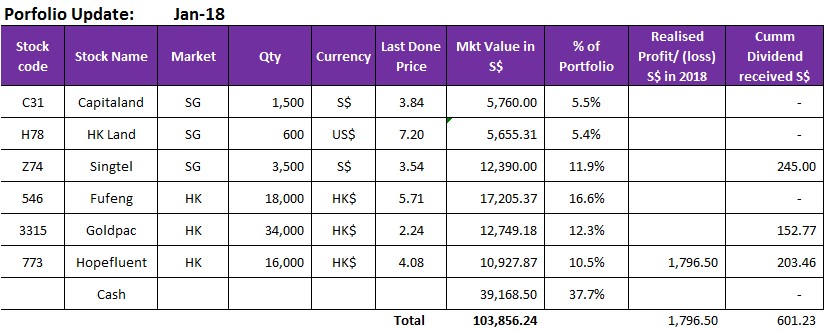
Stock Sniper's Portfolio For January 2018


Read about Stock Sniper's Portfolio HERE


The opening month of 2018 saw quite a bit of activities in this portfolio, with two new stocks added, increased exposure in one current holding and partial profit taking in another. 
Higher cash amount had been deployed and the cash position fell to below 40% of total portfolio.
 
Transactions done in Jan 18:

1. CapitaLand Limited
 
Initiated new position.
 
CapitaLand Limited is one of the Asia's largest real estate companies based in Singapore. Quick analysis of the company can be found HERE.
 
With the expected pick up in the economies around Asia, property sector may be one of the beneficiaries. Singapore private property market which has been subject to Government's cooling measures has also shown signs of improving sentiments. While China residential property market has also been under Government's control measures, share prices of property stocks have rallied strongly recently on sales optimism and expectation on relaxation of cooling measures.


CapitaLand, having strong presence in both markets (83% of total assets), has been trading near multi-year low valuation in terms of PE and Price over book value. Moreover, CapitaLand has been growing its recurring income from investment properties (85% of total assets are contributing to recurring income as at Sept 17) and have recently increased its dividend payout which appears to be sustainable.

With improving outlook and sentiment, CapitaLand could trade closer its historical mean of 1 to 1.1x its book value which is currently at $4.29 as at Sep 17, i.e. fair value of $4.29 to $4.70. 

At the purchased price, dividend yield of 2.7% is pretty decent.

Risks:
1. Property business, especially residential property development can be quite cyclical, subject to the health of the economy as well as Government's policies.
2. Rising interest rates might increase the financial burdens of property companies with high gearings, adversely affect capitalization rates used for property valuations and dampen buyers' appetite for properties.
 
 
2. Hongkong Land Limited

Initiated new position.

Founded in 1889, Hongkong Land is a listed leading property investment, management and development group.  The Group owns and manages almost 800,000 sq. m. of prime office and luxury retail property in key Asian cities, principally in Hong Kong and Singapore.
Its Hong Kong Central portfolio represents some 450,000 sq. m. of prime property. It has a further 165,000 sq. m. of prime office space in Singapore mainly held through joint ventures, and a 50% interest in a leading office complex in Central Jakarta. The Group also has a number of high quality residential and mixed-use projects under development in cities across Greater China and Southeast Asia, including a luxury retail centre at Wangfujing in Beijing. In Singapore, its subsidiary, MCL Land, is a well-established residential developer. Majority of its assets are investment properties producing recurring income.

The investment thesis for Hongkong Land is almost the same as CapitaLand, at current price, HK Land is trading at huge discount to its book value of more than 50%, dividend yield of about 2.7%. 


Based on its half year announcement, Hongkong Land is expecting a "solid" full year performance.
 

3. Fufeng Group 

Increased position.

The share price had experienced quite a bit of volatility at the beginning of Jan, which may be due to the raise in corn prices in China since last quarter. There were reports that the China state grains stockpiler had started to sell corns from its stockpiles to meet demands and also China imports from USA and Ukraine, and this could moderate the price increase.

As corn is the major cost component in Fufeng's business, it is worthwhile to keep a close tab on its market outlook.


3. Hopefluent 
 
Taken partial profits.

In late Jan, Hopefluent announced a Framework agreement with another large SSE listed property co, Poly Real Estate Group (RMB201B mrk cap) with both companies transferring their the primary & secondary real estate agency business to a new JV. Under the Framework, Hopefluent shall hold 55 - 65% of the JV and Hopefluent shall issue 5% new shares to this partner at HK$4.20 to strengthen the cooperation. This agreement is still subject to the completion of due diligence expected by May 18.

My initial thoughts
1. There is potentially more primary business from new property launches from this big property developer
2. Removed direct competition in the primary and secondary real estate agencies with Poly Real Estate Group upon completion of the deal
3. Hopefluent will be flooded with even more cash from this new share issuance!


The market got excited on this news in the next trading day and the share price jumped more than 12% to as high as HK$4.60 before closing at HK$4.16.

While the ex-cash valuation of Hopefluent at current price is still not demanding, the exposure to property sector in this portfolio has increased substantially after adding CapitaLand and Hongkong Land and I deemed an adjustment was necessary. Therefore, I took the opportunity of share price spike to realize some profits on this investment made in Aug-Sep 17, netting an average gain of more 30% (or than more than 60% gain on an annualized basis), not counting the dividend received.
 
(Refer to previous postings on this company HERE)
 
News Review for the rest of Portfolio companies during the month:

Goldpac:

Readers might recall that I had written about Goldpac being hit by exchange losses due to  currency translation of its huge USD balance as RMB strengthened against USD during the half year period end Jun 2017.

In the previous financial year, it was reported that approximately 49% of Goldpac's huge cash hoards were in USD & HKD.

If its currency exposure remained the same without hedging done, with continue weakening of USD (note that HKD is also pegged to the USD) since Jun 17, it should not be a surprise that Goldpac would suffer greater exchange losses in the 2nd half period as USD continued to weaken against CNY

In Jan 18, Goldpac was honored with "Best Value TMT Company” for Golden HK Stock Award, 2017.
 
(Refer to previous postings on this company HERE)


Connect @ Facebook

Read Disclaimer

Friday, January 12, 2018

Stock Sniper's Portfolio For December 2017


Read about Stock Sniper's Portfolio HERE

 
Transactions done in Dec 17:

1. Fufeng Group

Initiated a new position in this company.

 
Fufeng is the largest manufacturer of MSG and Xanhtan Gum in the world.

The competition in the MSG market has eased since 2016 with many unprofitable small and mid sized producers exited the market after years of price competitions. With the liberalization of the corn market in the Northeast China and Inner Mongolia, Fufeng benefited from the lower input costs in 2016 and 1st half of 2017. Also, it completed the first phase of its manufacturing plant upgrades in 2016 which helped to improve the efficiency and lower its manufacturing costs. The Xanhtan gum prices also started to improve in 1st half 2017 after years of sluggishness due to low oil prices and demand.


Back by these positive factors, Fufeng reported a revenue growth of 5.1% and profit growth of 111.6% in 2016 and revenue growth of 12.7% and profit growth of 83.4% in 1st half of 2017. Note that the net profit growths were much faster as compared to the revenue growth due to improving gross profit margins as Fufeng had adopted a competitive pricing stance to consolidate its  market share leadership.

Key risks: Input cost of corn.

2. Singtel

Increased position slightly to take advantage of the price weakness after the share went ex-dividend. At this current price, it offers a dividend yield of 4.9% excluding special dividend.
(Refer to related articles HERE)
 
 
News for the rest of Portfolio companies during the month:

1. Goldpac:

(i) Goldpac announced receiving following awards:
a.  Model Enterprise for the "Mass Entrepreneurship and Innovation" and "Innovative Pilot Enterprise"
b. Enterprise for the 2017 Strategic Emerging Industries (Intelligent Manufacturing) 
 
Once again, these awards are further testimonies to Goldpac's leadership in the industry.
 
(ii) Executive Chairman, Mr Lu, purchased 1 million shares at the price of $2.10 as the share price experience much volatility in Dec 17.
 
(iii) On a side note, Gemalto, its substantial shareholder and strategic partner, accepted the buy out offer from Thales. It is not clear whether this move would have any impact on Goldpac at this juncture.
(Refer to related articles HERE)

2. Hopefluent:


Executive Chairman, Mr Fu continued to purchase more shares in Dec 17, buying a further 4,894K shares at an average price of $3.47.

For 2016, the insiders (Mr Fu and his wife, Ms Ng, both Executive Directors of the company) had recorded a total purchase of 13.3 million shares at an average price of $3.57, spending a total of HK$47.48 million.
(Refer to related articles HERE)

Overall, at the end of 2016 the portfolio is only about 50% invest. Shall keep on hunting for good value stock in 2017!

Connect @ Facebook

Read Disclaimer

Saturday, December 16, 2017

Stock Sniper's Portfolio For November 2017


Read about Stock Sniper's Portfolio HERE

 
Transactions For Nov 17:

There was no new transaction done in Nov 17.

News of Portfolio companies during the month:

1. Singtel:

Singtel announced its Q2 result with profit increased by 197% to S$2.9b on NetLink Trust divestment. It also decided to pay a special dividend of 3 cts.

Summary of operating results (source: The Business Times)
- Operating revenue for the quarter rose 6.9 per cent to S$4.37 billion from S$4.09 billion a year ago.
- Earnings before interest, tax, depreciation and amortisation up 5 per cent
- Underlying net profit for the quarter fell 4 per cent, impacted by Airtel, which continued to face intense price competition in India. This mainly led to a 10.6 per cent fall in associates' pre-tax earnings to S$648 million.

Apparently, the market wasn't too impressed by the results, and particularly the low amount of special dividend declared, being less than a quarter of the total proceeds of S$2.3b from Netlink Trust IPO. Singtel had stated that it would like to retain remaining the proceeds for investments. The share price initially dropped from almost the high of S$3.78 prior to results announcements to a low of S$3.66, before closing the month at S$3.76.

2. Goldpac:

There is no new announcement from the Exchange during Nov. However, Goldpac did announce its Smart Card shipments for the first Three Quarters in Oct which I had inadvertently missed:

- Smart Card Shipments: year-to-date growth of 8.6% to 135.59m
- Credit Card business: growth of 30%


Based on my own estimations and tabulations above, the growth of Goldpac's quarterly IC card shipments has continued into Q3, albeit at a slower pace compared to Q2. 


3. Hopefluent:


While there is no corporate news from Hopefluent, but there were quite abit of insiders' activities announced in Nov 17.


Non-executive Director, Mo Tian Quan had recorded his first sales of shares in Oct 17 since his last purchase through China-Net Holding (Soufun) of 700K shares at average price of HK$2.183 in 1st Dec 2016. Strangely, while these sales transactions were done in Oct 17, they were only recorded with the HKEx on 13th Nov 17. In total, Mr Mo sold 812K shares at an average price of HK$3.7252.

Is this share sales is a cause of concern?

In my opinion, it's a matter of time that Mr Mo would have to decide what to do with his investments in Hopefluent. As mentioned in my initial posting HERE, there have not been any apparent progress in the cooperation between Hopefluent and Soufun since its strategic investment in 2014. Mr Mo also had not been attending Hopefluent Board Meetings for the past two years according to the annual reports.

On the other hand, the Founders and Executive Directors recorded a total purchases of 2,496K shares at an average price of HK$3.5496 in Nov17.


Connect @ Facebook

Read Disclaimer


Thursday, November 2, 2017

Stock Sniper's Portfolio For October 2017


Read about Stock Sniper's Portfolio HERE


Transactions For Oct 17:

1. Singtel: Added into the portfolio in line with the objective of generative passive income from investments. Uninvested cash balance reduced to near 60% of the portfolio.

Reasons for purchase:
- From the desktop review HERE, it appears that Singtel has the best financial ability among the three Singapore telcos to ride out the rough patches from the increasing local competitions. Also, based on the financial ratios, Singtel has the best ability to sustain its current dividend payout. At this price, the dividend yield is expected to be 4.5%.

Review of other investments:

1. Goldpac:

- There is no new announcement from the Exchange during the period.

- However, on the corporate side, Goldpac did announce that it provided to the China Merchants Bank, an exclusive "Blockbuster " King of Glory co-branded credit card which looks quite cool.


- Still Trading at around 2x ex-cash PE. Valuation HERE


2. Hopefluent:


- Executive Chairman, Mr Fu bought a further 500,000 shares at an average price of HK$3.7195 during the month.

- Property related stocks took some beating during the month as there were news that property sales in China dropped for the first time in more than two-and-half years in September and housing starts slowed sharply.

- The PRC leadership also announced during the 19th Party Congress in October that it would be curbing speculative demands in the property market with tightening measures to cool down the housing prices further and so that housing can be within the reach of the masses.

- Are these developments a cause of concern for Hopefluent?

When the investment decision was first made with this analysis, it had already been expected that the property cooling measures would impact the number of transactions in the short term. Hence, these developments should not come as a surprise. In fact, having a stable property price and enhancing affordability to the masses would improve the demand over long term. The new land releases by the government would also increase the supply of new properties that the property companies and its agents can sell. Hopefluent does not take the risk of property, it just earns from broking property transactions.

- With a strong balance sheet, Hopefluent should have no problem to tide it through. There is still high MOS with net cash/share. See valuation HERE

Connect @ Facebook

Read Disclaimer

Saturday, October 7, 2017

Goldpac: Discussion Points And Comments


Dear Readers,

Thank you for your interests in the articles on Goldpac (金邦达:3315.HK)  and your points raised. For the benefit of the other readers, some discussion points and comments are reproduced here.

If this is your first visit to this blog, you may want to read the previous postings on Goldpac before proceeding with this write-up.

Previous Posts:
31 July 2017 - Goldpac: Is There Gold in Goldpac?

16 September 2017 - Goldpac: Operating Profit Increased 16.3% For First Half 2017, But Net Profit Hit By Exchange Loss


30 September 2017 - Goldpac: Scored Double First As Selected Provider for New OTO Initiatives To Improve the Banking And Payment Ecosystem


The discussions here contain the opinions and ideas of the author. It is not a recommendation to purchase or sell the securities of any of the companies or investments herein discussed. Please refer to the disclaimer found at the bottom of this page.
 

Discussion Point 1: Goldpac is hoarding huge cash, is it a bane (or a boon)?

Comment:

The ROE of Goldpac is actually significantly under-stated due to the huge cash holdings which are not invested to generate business income.

However, having huge cash holdings may have the following significance:

(a)    Prudence spending by Management

Goldpac raised HK$975M in late 2013 IPO.

 
Amazingly, HK$345M (35%), mostly related to R&D, expansion of production facilities and future strategic M&A, still remained unutilized as of end 2016. This demonstrates the prudence on the part of its Management in making new investments and there will be ready cash to deploy once good investment opportunity arises.


In January 2017, Goldpac has announced the acquisition of a piece of land in Zhuhai and the development of Goldpac Fintech Innovation Hub to grow its Fintech business. (Refer to more information here)

(b)    Highly cash generative business

Since IPO, from 2014-2016, Goldpac had generated a total of RMB813M in operating cashflow while cumulative CAPEX over the same period was RMB117M, giving a free cashflow of RMB696M. This is almost 40% of its current market capitalization!

 
This shows that Goldpac is a highly cash generative business with low maintenance CAPEX. In fact, Goldpac has invested a lot on technology to improve its manufacturing process and has recently signed a strategic cooperation with Infineon to improve its production through Industrial 4.0.

(c)      Rewarding its shareholders and sustainability of dividends

Goldpac had been paying its shareholders dividends every year since IPO. In fact, it has been raising its dividend per share each year and special dividends had been introduced since FY15. 


From 2013 to six month ended 2017, a cumulative dividend amount of RMB351M had been paid. With high free cashflow, it is likely that Goldpac could continue to reward its shareholders with dividends. Also, Goldpac had executed share buybacks in 2015 & 2016 and cancelled a total of 1.4 million shares. 

From these actions, it can be seen that Management had been returning excess cash to the shareholders.


In fact, Goldpac was honored with the “Best Shareholders’ Return” award in the 2016 Golden Hong Kong Stock Award Competition which recognized the Group’s profitability and consistent dividend policy. (Refer to Chinese article here)
 
Discussion Point 2: Mobile payments such as AliPay and WeChat Pay are growing rapidly in China. Will credit card be skipped altogether?

Please refer to comments under Discussion Point 3.

Discussion Point 3: Would NFC (Near-field communication) payment replace credit card payment?

 
Comments:

China has managed to frog leap and skip certain stages in its technology adoption due to the lack of historical baggage as it did not previously have huge existing infrastructure in place for payment devices as compared with other developed countries. Thus China can rapidly set up NFC enabled payment systems in its MPOS network without the need to replace huge existing network. In addition, the high adoption rate of smart phone in China has enabled usage of mobile payments such as AliPay and Wechat Pay to grow rapidly for small amount payments through the use of QR codes. AliPay and Wechat Pay have been offering small discounts and Hongbaos (lucky draws) for its users and these have worked well to attract users. These developments have generally reduced the usage of cash, especially in the cities.

So is credit card dead? From the feedback of some PRC friends working and living in China cities, the answers gathered from were resoundingly “NO”. They have commented that most of the people working in China cities do own credit cards and they do use it for the following purposes:

i) for higher value purchases
ii) to get longer repayment period
iii) overseas travels for hotel & purchase payments

It is interesting to know that even students from better known universities are being offered credit cards even though they do not have any income yet. Basically, it is not a binary outcome between ewallets and credit cards, they are different modes in the payment ecosystem that can co-exist, and both aimed at replacing cash transactions.

Compared with NFC payments, it should be noted that credit card also provides an additional important function - CREDIT i.e. lending during payment process, and not just solely to facilitate payment. Mobile payment and credit card payments are different mode of payments with different features, it all will work together to move into cashless society.

Click here for Chinese language interview with Chairman of Goldpac in Nov 2016 on why he thinks e payment cannot completely replace bank card payments.

Discussion Point 4: Debit cards have been replaced, why can’t credit card be replaced by virtual credit card?

Comment:

Debit cards have NOT been replaced. JD.com has just jointly issued its first internet banking card with China Industrial bank and Goldpac has been appointed as the major supplier. (Refer to article here)


Goldpac has also just been appointed to issue a bluetooth ready bank card which can link to mobile phone for download payment apps.
 
There are evidences of e-commerce players and financial institutions using bank cards to link with internet banks & mobile phones to improve O2O connectivity. More importantly, they have chosen Goldpac as the provider of these initiatives and this illustrated Goldpac's leadership in the industry.

You may refer to write-up on the above New OTO Initiatives here.

Currently, none of the major credit card organisations has issued virtual-only consumer credit card. It is highly possible that the credit card networks (VISA, Mastercard etc) & credit card acquirers (banks) still want to be on "top of the wallet" for marketing visibility rather than to be hidden in mobile phones.

Physical bank cards are used as a marketing tools for the banks, clubs and merchants, by portraying income and status differentiation via the criteria used for qualifying each type of credit cards. In China, in order to attract users, the banks have partnered with Goldpac to issue innovative bank cards such as LED smart cards and Sound smart cards. Moreover, the costs of issuing bank cards only constitute a small portion of the overall costs of the banks according to Goldpac.
 
Discussion Point 5: What are the competitive advantages of Goldpac?

Comment:

Advantage #1 – High entry barriers to industry

-      Stringent security, qualification and certification requirements
-     Card manufacturers must have five years of relevant production experience to obtain certification from payment organisations

 
Advantage #2 – Only Card Provider Certified by six leading credit card organisations
 

-     Goldpac is the only card provider in China that is certified by all the 6 leading card issuance organisations ; Visa, Mastercard, Amex, Unionpay, Diners & JCB

 Advantage #3 – High switching cost for customers/ long relationship with customers

-     Goldpac has worked many years with banks in China and counts top banks like ICBC, BOC, ABC & CCB as its customers
-     Over the years, it has expanded its business relations to foreign banks as well as non-banking customers such as Starbucks.

-     Card issuers are reluctant to change card manufacturers frequently due to security and trust issues
-     One non-executive Director was a board representative nominated by BOC group
-      Long time relationships build trust and enhance the chance of winning new business, e.g. providing Fintech solutions to banks

Advantage #4 – Strategic partnership with major supplier

-     Major supplier, Gemalto holds 18.42% share interests and has nominated a board representative in Goldpac
-     Gemalto is the world leading supplier of IC chips and digital security provider
-     According to Management in an investors communication meeting held on 20 April 2017:

Goldpac and Gemalto are important strategic partners. We form powerful combination in the business level and increase the bargaining power and market ability. Gemalto attaches importance to the company`s growth in China market and overseas development. In overseas markets, although the two companies have some competition, we have different market advantages. Goldpac has more advantages in the international development of UnionPay products and in Southeast Asia market. Because of the needs of risk management, the world`s banks are trying to avoid centralized procurement, so the company has great development and cooperation opportunities in overseas markets.

Advantage #5 – Strong Innovation Capability

-      25% of total workforce of 1,600 are engaged in R&D. Invest ~7% of revenue on R&D
-      Collaboration with Wuhan University on IoT solutions
-      Collaboration with Infineon on Industrial 4.0 to improve productivity and cost efficiency


Evidence: Goldpac won numerous awards for its product innovations over the years, including:
-     GCaas, its Fintech solution for banks and financial institutions
-     ICMA Elan Award, which is the Oscar’s equivalent for the industry
-     Goldpac was selected as major provider for first ever internet savings bank card issued under the partnership between JD.com and Industrial Bank as well
-     Goldpac was selected as major provider for the first Bluetooth bank card
 
Discussion Point 6: What are the opportunities Goldpac’s business?

Comment:

1.       Low Credit Card Penetration Rate

According to estimates, the credit card penetration rate in China is only less than 0.32 per capita compared to 4-6 per capita for debit cards. If conservatively, the credit card penetration rate can increase to 1 per person, then the addressable market is more than twice the current size.

2.       Entry by VISA, Mastercard card and other credit card organization into China

Moreover, due to WTO agreement, China is opening up its domestic credit card market to allow foreign credit card networks such as VISA & Mastercard into China market. Once they entered, it is expected that credit card issuance will increase. The competition for credit card market will intensify and it is likely to bring down the credit card charges and credit card interest rates. This will simulate the growth of credit cards as a form of payment financing.

3.       Low EMV migration rate in Asia Pacific & China UnionPay Belt & Road Initiatives


EMVCO has set a deadline for mandatory migration of existing magnetic stripe credit card to EMV compliant standard for better security.

According to EMVCO statistics, the EMV card adoption rate in Asia Pacific is only 38.8% percent in 2016. Goldpac has made inroads into South East Asia, in particularly, Philippines to take advantage of the EMV migration and it has also set up Fintech operations in Singapore. In 2016, the overseas sales is only RMB103M or less than 8% of its annual sales. The migration to EMV standard is expected to accelerate as the EMVCo deadline approaches.

4.       Growing Recurring Income from Payment Card Replacement Market

Credit card expiry period is typically set at 3 to 5 years due to credit review required on the card holder by the banks. This provides a future recurring income to the providers for credit card replacement market. So even at zero growth, based on the current financials, Goldpac can easy continue its high dividend payout given its low maintenance CAPEX requirement.
 
5.       Growing Innovative Payment Products & Fintech Business

While the current card solution business can be seen as a steady growth cash-cow business, the Star for rapid growth would be its Innovative Payment Products & Fintech business.


Goldpac has developed an award winning Fintech technology for banks and financial institutions, GCaaS, which uses cloud based technology to integrate secured e-commerce, business management and linked up card issuers, merchants and cardholders in data processing.


Goldpac CTO, Li Jun, briefing on Goldpac’s GCaaS at the 2016 AliCloud Fintech Summit

 
In one interview, a Goldpac executive had mentioned that the company is in a good position to leverage on its relationships and trust developed over many years with the PRC banks to implement secured Fintech solutions to help them rationalize their costs. Of the 1,600 workforce in Goldpac, 400 of them are engaged in R&D for secure payment solutions including Fintech.


High-end Garmin Smart Payment Sport Watch supplied by Goldpac to China Industrial Bank.

According to estimates by HIS Markit reported in Goldpac’s announcement, the wearable market size in China was expected to grow to RMB20B.

In the six months ended 2017, the sales of wearables products was near RMB10M. As both wearable payment products and Fintech solutions are still at its early growth stage at Goldpac, there are great potentials to develop these businesses in years to come.

For a company that is ranked first in China and fourth in the world in the financial cards industry, Goldpac is trading at near 2x ex-cash PE (TTM) at current price. (view valuation here)

For new posting alert on this blog, please click on the link below:
Subscribe to Hunting For Value by Email
 
 
Previous Posts:

31 July 2017 - Goldpac: Is There Gold in Goldpac?

16 September 2017 - Goldpac: Operating Profit Increased 16.3% For First Half 2017, But Net Profit Hit By Exchange Loss


30 September 2017 - Goldpac: Scored Double First As Selected Provider for New OTO Initiatives To Improve the Banking And Payment Ecosystem
 

Connect

Featured Post

Launch of Stock Sniper's Model Investment Portfolio

Please read the disclaimer before you proceed with the rest of the article. This portfolio is a mock-up model to test the investment thes...